Cristiano Ronaldo’s Transformation Overview
Few athletes have rebuilt their own body as deliberately as Cristiano Ronaldo. The Portuguese forward arrived at Manchester United in August 2003 as an 18-year-old winger with quick feet, a mop of gelled hair and a frame slight enough that Premier League defenders openly targeted it. Two decades later, he is a 1.87 m (6 ft 1 in) forward carrying 83–85 kg of dense muscle, and he is still scoring professionally in his 40s — a physical outcome that no scouting report in 2003 predicted.
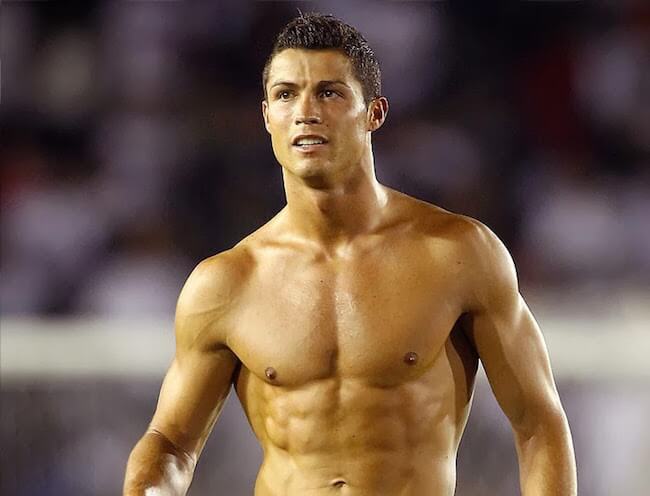
The transformation wasn’t triggered by a film role or a health scare. It was triggered by getting kicked. Ronaldo has repeatedly described the first two seasons in England as a period when he realized talent alone wouldn’t survive contact with Premier League full-backs. Manchester United’s power development coach Mick Clegg began working with him in the gym, often one-on-one, and Ronaldo added 12 kg of lean mass across his Old Trafford years — going from a reported 75 kg teenager to a sprinter-built forward who could outjump centre-backs.
The numbers that keep his name trending are the ones from Turin. When Juventus put him through medical screening after his 2018 transfer, club-reported figures listed his body fat at around 7% and his muscle mass near 50%, against squad averages of 10–11% and 46%. Those figures, plus the frequently repeated claim by Juventus medical staff that his “biological age” tested far younger than his birth certificate, have become permanent internet currency — resurfacing after every major tournament, every shirtless celebration and every longevity interview.
Transformation Timeline
2003: The Starting Point
Ronaldo signed for Manchester United from Sporting CP for around £12.24 million. He was skinny by professional standards — long-limbed, low body mass, built for acceleration rather than collisions. Sir Alex Ferguson’s staff identified strength as the limiting factor almost immediately. Ronaldo started staying behind after team sessions for extra gym work with Clegg, focusing on explosive power, core stability and single-leg strength rather than bodybuilding-style hypertrophy.
2006–2009: The Turning Point
This is the stretch where the physique everyone now recognizes was actually built. By the 2007–08 season — 42 goals in all competitions, the Ballon d’Or, a Champions League title — Ronaldo had converted from a wide dribbler into a direct goalscorer who could win aerial duels against centre-backs. The extra mass changed his game: he began attacking crosses, holding off defenders and finishing with either foot. He left for Real Madrid in 2009 for a then-world-record €94 million, listed at 84 kg.
2009–2018: Peak Conditioning at Real Madrid
Nine seasons, 450 goals in 438 appearances, four Champions League titles. Ronaldo’s body composition barely fluctuated across this period, which is the genuinely unusual part. He installed a full gym and a cryotherapy chamber at his Madrid home, hired chefs to control his meals and began working with sleep coach Nick Littlehales, who restructured his rest into multiple 90-minute sleep cycles rather than one long block. His teammates and coaches have consistently described his off-season conditioning as indistinguishable from his in-season conditioning.
2018–2021: The Juventus Medical Tests
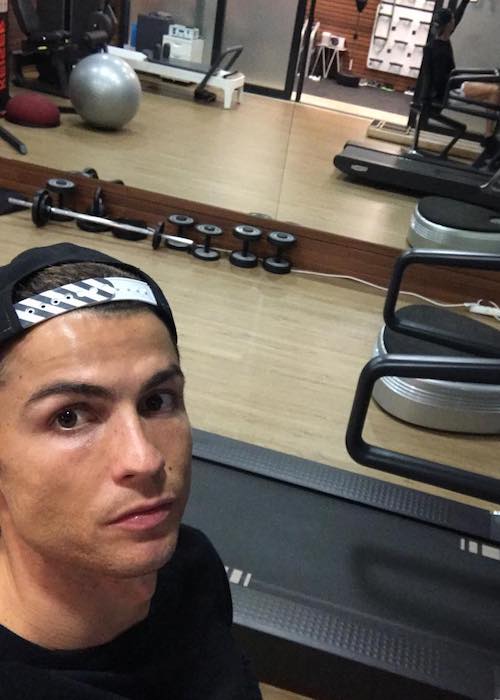
The Turin move produced the data points that still drive headlines. The 7% body fat and 50% muscle mass figures came from this period, alongside the widely circulated claim that his biological markers resembled those of a man in his twenties. His December 2019 header against Sampdoria — reportedly hanging in the air long enough to meet the ball at around 2.56 m — became the visual proof. Patrice Evra’s story about being served a dinner of plain chicken, salad and water at Ronaldo’s house, then dragged into a post-meal training session, dates from their Manchester days but went viral all over again during the Juventus years.
2021–2022: Manchester United Return and the Qatar World Cup
Ronaldo returned to Old Trafford in August 2021 at 36 and scored 24 goals in his first season back — his body holding up even as the team collapsed around him. The 2022 World Cup in Qatar was harder. Portugal exited in the quarter-finals against Morocco, Ronaldo started two matches from the bench, and the narrative shifted from “how is he still this fit” to “how much is left.” His contract with United was terminated by mutual agreement that December following the Piers Morgan interview.
2023–2025: Al Nassr and the Longevity Phase
Ronaldo joined Al Nassr in January 2023 and promptly kept scoring at a rate that made the “decline” framing look premature — including his 900th career goal in September 2024 and a Portugal Nations League title in June 2025. He extended his Al Nassr contract through 2027. Photographs from Saudi training sessions show a physique that has changed subtly: slightly less upper-body bulk than his Real Madrid peak, more emphasis on hip mobility, tendon health and recovery. That’s the standard adaptation for an ageing power athlete, and it’s the version of his routine that now gets dissected after every tournament cycle.
Diet Changes
Ronaldo doesn’t follow a branded diet. He follows frequency and consistency. He eats five to six small meals spaced three to four hours apart — a structure his former personal chef Giorgio Barone described publicly during the Juventus years — which keeps protein intake distributed and blood sugar stable across long training days.
The staples are lean protein and complex carbohydrates: chicken breast, turkey, swordfish, sea bass and cod, with whole grains, green vegetables, salad and fruit. His favourite dish is bacalhau à brás, the Portuguese salt cod, potato and egg dish from his Madeira upbringing. Breakfast frequently includes eggs, avocado, ham and cheese, plus a protein shake.
What he removes matters as much. Ronaldo does not drink alcohol — his father, Dinis, died in 2005 at 52 from alcohol-related liver failure, and Ronaldo has cited that repeatedly. He avoids sugary soft drinks, a stance that became a global news event at Euro 2020 when he moved two Coca-Cola bottles off the press conference table and held up a water bottle. He has also said he avoids fizzy drinks and heavily processed food almost entirely, and limits fried foods.
Workout Changes
The early Manchester United work under Mick Clegg was power-focused: Olympic-style lifts, plyometrics, reactive drills, and heavy attention to unilateral leg strength for the jump and the sprint. It was never about maximum size — it was about force production in a frame that still had to cover 10+ km per match.
Through the Real Madrid decade, Ronaldo settled into three to four hours of training per day, five days a week, split between pitch work and gym. Core training is the constant — he has described high-volume abdominal circuits, and his midsection has been the single most photographed part of his transformation. Cardio came from sprint intervals and technical work rather than long steady-state running.
The modern version leans harder into recovery. Cryotherapy, structured napping (Littlehales’ polyphasic model built around 90-minute cycles), hydrotherapy, and wearable monitoring — Ronaldo became an investor in and user of the recovery-tracking platform Whoop in 2021. Less maximal loading, more mobility, more sleep. That’s the shift most 40-year-old athletes make, whether they admit it or not.
Before and After Stats
| Stat | Before (2003, age 18) | After (peak/current) |
|---|---|---|
| Weight | ~75 kg (165 lbs) | ~83–85 kg (183–187 lbs) |
| Height | 1.87 m (6 ft 1 in) | 1.87 m (6 ft 1 in) |
| Body Fat % | Not publicly recorded | ~7% (Juventus club-reported, 2018) |
| Muscle Mass | Not publicly recorded | ~50% (Juventus club-reported, 2018) |
| Build | Lean, wiry, narrow-shouldered winger | Dense, sprinter-built forward; broad shoulders, heavy quad and calf development |
Key Takeaways
Ronaldo’s transformation is unusually instructive because nothing about it is exotic. No extreme cut, no crash phase, no dramatic rebound. He added muscle slowly over six years, then held that composition for another fifteen through frequency, sleep, and food discipline. Consistency did the work that intensity gets credit for.
Three things transfer to non-athletes. First, eating on a schedule — regular, protein-forward meals — is easier to sustain than restriction. Second, removing alcohol and liquid sugar produces outsized results relative to how simple the change is. Third, sleep is a training variable; Ronaldo treats it with the same seriousness as squats.
The caveats are real. Three to four hours of daily training with a full-time chef, physio team and home cryotherapy chamber is not a template for anyone with a job. The 7% body fat figure is a professional-athlete number, not a health target — most men function best well above it. And the recurring “biological age” claims are club and media reporting, not peer-reviewed science. Admire the discipline, borrow the habits, skip the numbers.
Frequently Asked Questions
How tall is Cristiano Ronaldo?
Cristiano Ronaldo is 6 feet 1 inch tall (187 cm). He is one of the taller forwards in elite football, which helps explain his aerial dominance.
How much does Cristiano Ronaldo weigh?
Ronaldo weighs approximately 84 kg (185 lbs). He reportedly maintains a body fat percentage in the single digits, around 7-8%.
How old is Cristiano Ronaldo?
Cristiano Ronaldo was born on February 5, 1985, in Funchal, Madeira, Portugal. That makes him 40 years old as of 2025 and 41 in February 2026.
What is Cristiano Ronaldo’s net worth?
Cristiano Ronaldo’s net worth is estimated at over $1 billion, making him one of the first footballers to reach billionaire status. His fortune comes from club salaries, his Al Nassr contract, endorsements, and the CR7 brand.
Who is Cristiano Ronaldo dating?
Ronaldo is in a long-term relationship with Argentine-Spanish model Georgina Rodríguez, whom he began dating in 2016 and became engaged to in 2025. The couple shares several children within Ronaldo’s larger family.
What is Cristiano Ronaldo known for?
He is known as one of the greatest footballers of all time, a five-time Ballon d’Or winner and the all-time leading goalscorer in men’s international football. He has starred for Sporting CP, Manchester United, Real Madrid, Juventus and Al Nassr.
What does Cristiano Ronaldo’s diet and workout routine look like?
Ronaldo eats around six small high-protein meals a day, favoring fish, chicken, whole grains and fruit while avoiding alcohol and sugary foods. He trains up to 3-4 hours daily, combining sprint work, plyometrics, core circuits, and weight training, plus strict sleep routines.
Trending Now
Recommended Fitness Gear
Last Updated: October 25, 2026 | Source: Healthy Celeb