This article contains affiliate links. We may earn a small commission if you purchase through these links, at no extra cost to you.
Mike Tyson’s Fitness Philosophy
Mike Tyson built the most imitated physique in boxing history without ever becoming a gym rat. At 5’10” and 218 lbs in his prime, he carried a 20-inch neck, a thick upper back and legs that let him generate power from the floor up. And he did almost all of it with bodyweight work, roadwork and ten rounds of sparring a day.
That’s the part people forget. Cus D’Amato and Kevin Rooney kept Tyson away from heavy barbell training because they believed it made fighters tight and slow. Instead, the teenage Tyson ran through an absurd volume of calisthenics every single day — the famous routine that’s still one of the most-searched workouts in combat sports. Push-ups, dips, sit-ups, shrugs, neck bridges. Repeat. Seven days a week.
At 59, he’s still training, just not like that. The 2026 version is shorter, lower-impact and built around keeping his body functional enough to take exhibition bookings — including the Floyd Mayweather exhibition that’s been floated for spring 2026.

Image: Super Festivals / CC BY 2.0, via Wikimedia Commons
Training Split
In the Catskill days there wasn’t really a split. Tyson did the same work every day, broken into blocks from 4 a.m. to 10 p.m. Here’s how that day was structured, followed by what a modern week looks like for him.
Day 1 (and 2, and 3): The Classic Tyson Day
- 4:00 a.m. — 3 to 5 mile road run
- Back to bed, then breakfast and 10 rounds of sparring
- Sit-ups — 2,000 reps (broken into sets of 25-50 throughout the day)
- Push-ups — 500 reps
- Dips — 500 reps
- Barbell shrugs — 500 reps with a 66 lb bar
- Neck bridges — 500 reps, plus 10-30 minutes of static bridging
- Heavy bag, speed bag, slip bag, double-end bag — 60 minutes total
- jump rope — 20-30 minutes
- Stationary bike — 30-60 minutes in the evening
Rest between calisthenic sets was minimal — 30 to 60 seconds. The whole package was spread across four or five sessions a day rather than crammed into one brutal block, which is the detail most people copying the routine get wrong.
Day 1 (Modern): Boxing Skills + Mitts
- Shadowboxing — 3 rounds
- Focus mitts with the trainer — 6-8 rounds x 3 min
- Heavy bag — 4 rounds
- Core circuit: sit-ups, leg raises, Russian twists — 3 rounds, 60 sec each
Day 2: Conditioning and Lower Body
- Treadmill or assault bike intervals — 20-25 minutes
- Bodyweight squats — 3 sets x 25
- Walking lunges — 3 sets x 20 steps
- Step-ups — 3 sets x 15 per leg
- Resistance band lateral walks — 3 sets x 20
Day 3: Upper Body Push/Pull
- Push-ups — 5 sets x 25-40
- Dips — 4 sets x 15-20
- Dumbbell rows — 4 sets x 12
- Shrugs — 4 sets x 20
- Neck harness or manual neck resistance — 3 sets x 15 per direction
Day 4: Sparring or Active Recovery
During fight camp this is live rounds. Outside camp it’s pad work, stretching and a long walk.
Cardio Routine
Roadwork was non-negotiable under Rooney — 4 a.m., three to five miles, usually in boots. Tyson has said the early hour was psychological as much as physical: D’Amato wanted him to know his opponent was still asleep.
These days his knees don’t take pavement well. For the Jake Paul camp he leaned on the treadmill, the stationary bike and round-based bag work instead — about 30-45 minutes of cardio six days a week, kept at a steady aerobic pace rather than sprint intervals.

Image: Steve Lott / CC BY-SA 3.0, via Wikimedia Commons
Fight-Camp Training
Tyson’s 2020 return was the real transformation. He dropped about 100 lbs across 2019-2020 — from around 320 lbs down to 220 — before the Roy Jones Jr. exhibition on 28 November 2020. That camp ran about six months and combined twice-daily boxing sessions with a stripped-down diet.
The Jake Paul camp was longer and messier. Originally set for 20 July 2024, the fight got pushed to 15 November 2024 after Tyson suffered an ulcer flare-up on a flight in May. He rebuilt and weighed in at 228.4 lbs at AT&T Stadium at age 58, losing on points over eight two-minute rounds. Camp length, counting the restart: close to a year.
Recovery and Flexibility
Tyson is open about using cryotherapy, ice baths and regular massage, and he’s been outspoken about cannabis as part of his recovery and pain management. He also does daily mobility work — hip openers, hamstring and shoulder stretching — which matters more now than any amount of pressing.
Sleep was structured even in the 1980s: D’Amato had him in bed early so the 4 a.m. run was possible. In recent camps Tyson has talked about building naps into the day between the morning and evening sessions.
Personal Trainer
Historically, Cus D’Amato designed the system and Kevin Rooney enforced it. For both the Jones and Paul comebacks, Tyson worked with Rafael Cordeiro at Kings MMA in Huntington Beach, California. Cordeiro — better known for coaching Wanderlei Silva and Fabrício Werdum — rebuilt Tyson’s peek-a-boo combinations on the mitts while scaling the conditioning to a body that’s nearly 60 years old.
Workout Stats
| Metric | Detail |
|---|---|
| Training Frequency | 5-6 days/week (7 in the 1980s) |
| Session Duration | 60-90 minutes (up to 5 hours in his prime) |
| Primary Focus | Functional strength, muscular endurance, boxing conditioning |
| Cardio | Treadmill, bike, bag rounds — 30-45 min/day |
| Signature Work | 2,000 sit-ups, 500 push-ups, 500 dips, 500 shrugs, 500 neck bridges daily |
| Peak Fighting Weight | 218 lbs |
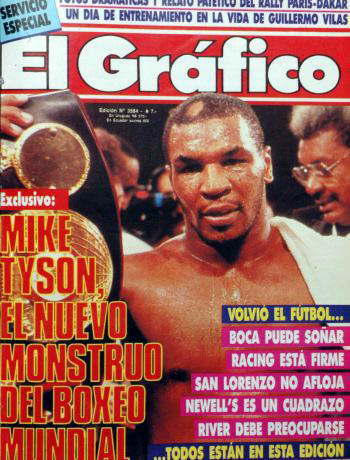
Image: Unknown authorUnknown author / Public domain, via Wikimedia Commons
If you’re going to steal anything from the routine, steal the structure — not the raw numbers. Nobody untrained should attempt 2,000 sit-ups. Tyson built to it over years, spread it across a full day, and had a 4 a.m. run and ten rounds of sparring on top. Start at a tenth of the volume and add from there.
Frequently Asked Questions
How does Mike Tyson work out?
Tyson built his prime physique almost entirely with bodyweight calisthenics, roadwork and sparring — push-ups, dips, sit-ups, shrugs and neck bridges rather than heavy barbell lifting. Today he trains a shorter, lower-impact version built around boxing skills, conditioning and mobility.
How often did Mike Tyson train?
In his Catskill days he trained seven days a week with no real split, spreading work across four or five sessions a day from 4 a.m. to 10 p.m. His modern week runs roughly four days: skills, conditioning, upper body, then sparring or active recovery.
Who is Mike Tyson’s trainer?
Tyson was shaped by Cus D’Amato and later Kevin Rooney, who deliberately kept him off heavy barbell work because they believed it made fighters tight and slow.
What exercises are in Mike Tyson’s classic daily routine?
The famous routine included 2,000 sit-ups, 500 push-ups, 500 dips, 500 barbell shrugs with a 66 lb bar and 500 neck bridges, plus bag work and jump rope. Rest between sets was only 30 to 60 seconds.
What cardio does Mike Tyson do?
Roadwork was non-negotiable under Rooney — three to five miles at 4 a.m., often in boots. He also used 20-30 minutes of jump rope and 30-60 minutes on a stationary bike in the evening; the modern version uses treadmill or assault bike intervals.
Does Mike Tyson take rest days?
In his prime, no — he trained all seven days. Now his fourth training day is sparring during camp, or pad work, stretching and a long walk outside of camp.
More Mike Tyson Celebrities

Trending Now



Recommended Fitness Gear
Last Updated: October 28, 2026 | Source: Healthy Celeb