Kimi Antonelli’s Fitness Philosophy
Andrea Kimi Antonelli turned 19 three weeks before the 2025 Italian Grand Prix, making him one of the youngest drivers ever to sit in a works Mercedes seat. He skipped most of a normal junior ladder — one season of Formula Regional, one of Formula 2, then straight into Lewis Hamilton’s old car. The physical side was arguably the steepest part of that climb.
At about 5’9″ and about 70 kg, Antonelli isn’t built like a bodybuilder and never will be. F1 punishes extra mass. The minimum combined driver-and-seat weight is 82 kg, so any muscle a driver adds has to earn its place. Everything he does in the gym aims at three things: holding his head up under 5G of lateral load, keeping his heart rate manageable for two hours in a cockpit that can hit 50°C, and staying sharp on lap 55 when a brake-by-wire change has just been radioed through.
He’s been in the Mercedes junior program since 2019, so the team’s human performance department has shaped his physical development since he was 12 or 13. That’s unusual — most drivers arrive in F1 and then get taught how to train.
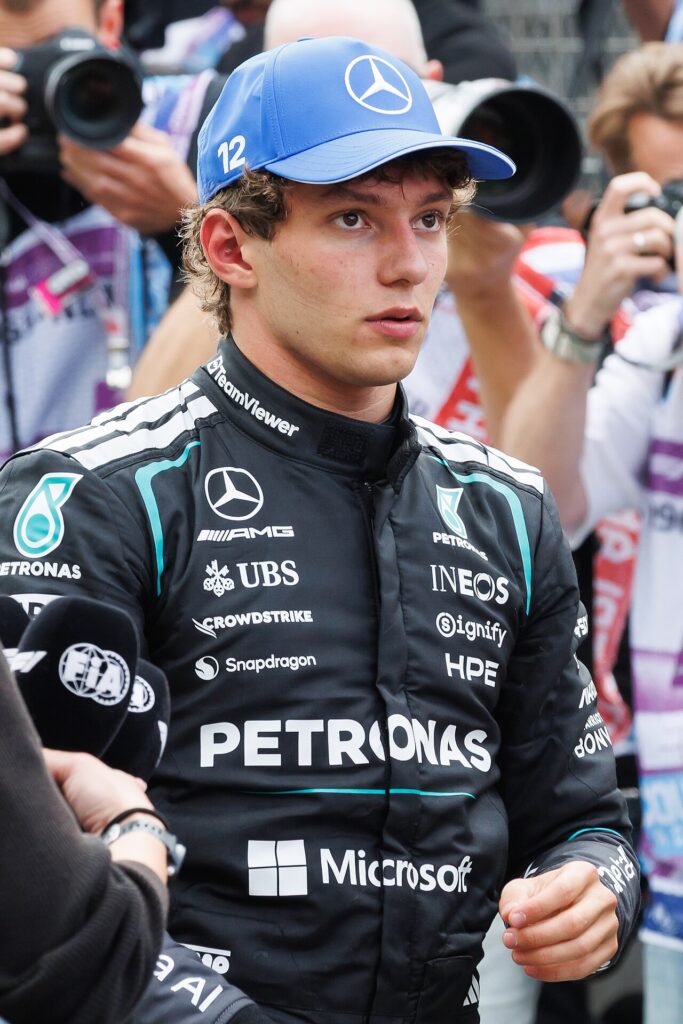
Image: Steffen Prößdorf / CC BY-SA 4.0, via Wikimedia Commons
Training Split
During the European leg of the season, drivers get maybe three usable gym days between races. Antonelli’s in-season week is short, frequent and neck-heavy.
Day 1: Neck and Upper Body Push
- Harness neck extension (plate-loaded) — 4 sets x 12-15 reps
- Lateral neck isometric holds against resistance band — 4 sets x 30-45 seconds per side
- Four-way neck machine (flexion, extension, both laterals) — 3 sets x 10 reps each direction
- Weighted helmet holds, head tilted to simulate corner load — 3 sets x 45 seconds per side
- Incline dumbbell press — 3 sets x 8-10 reps
- Seated shoulder press — 3 sets x 10 reps
- Cable triceps pushdown — 3 sets x 12-15 reps
Rest: 60-90 seconds between sets. 45 seconds on neck work.
Day 2: Cardio and Reaction Work
- Cycling intervals — 40-50 minutes, 4 x 5 min at threshold
- Reaction light board (Batak-style) — 6 rounds x 60 seconds
- Dual-task drills: reaction board while answering math or memory prompts — 4 rounds
Day 3: Legs and Posterior Chain
- Trap bar deadlift — 4 sets x 5-6 reps
- Bulgarian split squat — 3 sets x 8 per leg
- Single-leg press, emphasising left-leg braking force — 4 sets x 10 reps
- Romanian deadlift — 3 sets x 10 reps
- Standing calf raise — 3 sets x 15 reps
Left-leg strength matters more than it sounds. F1 brake pedals need 100-150 kg of pressure, applied 60-plus times a lap at a circuit like Montreal.
Day 4: Neck, Grip and Core
- Neck harness circuit (all four directions) — 4 rounds
- Farmer’s carry — 4 sets x 40 metres
- Plate pinch hold — 3 sets x 45 seconds
- Wrist roller — 3 sets to failure
- Pallof press — 3 sets x 12 per side
- Weighted side plank — 3 sets x 45 seconds per side
- Hanging leg raise — 3 sets x 12 reps
Day 5: Pull and Steady Cardio
- Pull-ups — 4 sets x 8-10 reps
- Single-arm dumbbell row — 3 sets x 10 per side
- Face pull — 3 sets x 15 reps
- Rowing machine or bike — 45-60 minutes steady state
Days 6-7: Race Weekend or Full Rest
No lifting within 48 hours of qualifying. On race weekends gym work drops to activation drills and neck priming before each session.
Cardio Routine
Cycling is the backbone: low-impact, it builds the aerobic base drivers need to hold 150-170 bpm for a full grand prix, and it doesn’t add bulk. Antonelli puts in long off-season road rides around Bologna and Emilia-Romagna, typically two to three hours, plus indoor trainer intervals during the season. Running is used sparingly — joint stress and race-week fatigue aren’t worth it.
Total cardio volume in-season: about 4-6 hours a week. In the winter break, that can double.
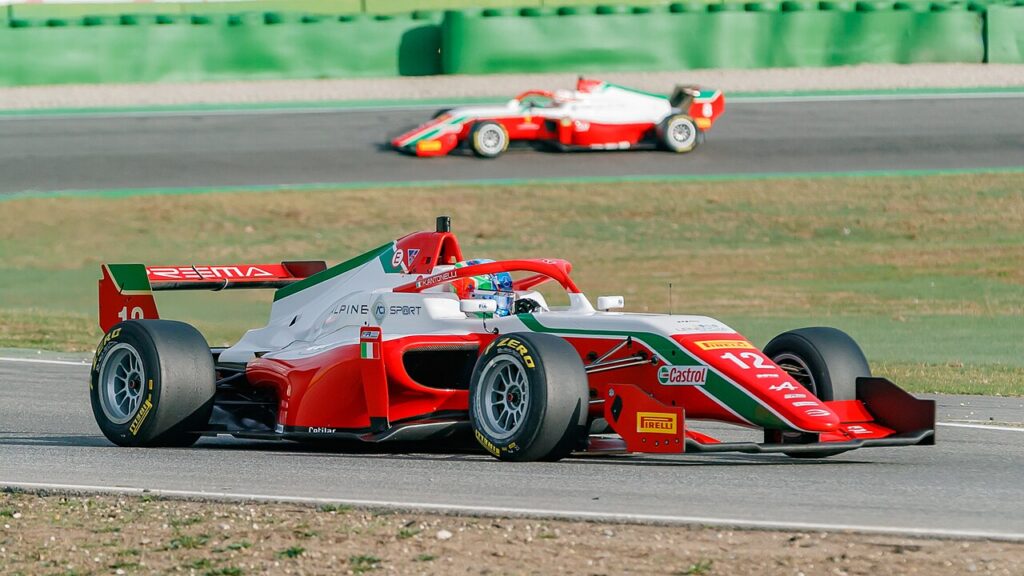
Image: Steffen Prößdorf / CC BY-SA 4.0, via Wikimedia Commons
Race-Specific Training
Not every circuit demands the same body. Suzuka, Silverstone and Jeddah are neck races — sustained high-speed direction changes loading the cervical spine lap after lap. Antonelli ramps up neck volume for two to three weeks beforehand.
Singapore and Qatar are heat races, and prep is completely different. Heat acclimatisation starts about 10-14 days out: cycling in a heated room or in full race overalls, 15-20 minute sauna protocols post-training, and strict sodium and fluid loading in the final 72 hours. Antonelli’s rookie Singapore run in October 2025 came after exactly that kind of block. Qatar 2023 saw multiple drivers need medical attention, so no one treats it casually anymore.
Recovery and Flexibility
Sleep is the non-negotiable — 8 to 9 hours, with the team managing light exposure and meal timing across time zones on flyaways. Mercedes travels with physios who handle soft-tissue work on the neck, traps and lower back after every session, since hours in a reclined carbon tub with almost no movement wreck thoracic mobility.
Mobility work is daily and short: 15-20 minutes of hip flexor openers, thoracic rotations, shoulder dislocates and cervical range-of-motion drills. Cold immersion after hot races. Nothing exotic.
Personal Trainer
Mercedes hasn’t publicised the name of Antonelli’s day-to-day performance coach the way Hamilton’s work with Angela Cullen became public. What’s known is that he’s been inside the Mercedes driver development structure since 2019, with the team’s human performance group — the same department that prepares George Russell — overseeing his strength, conditioning and cognitive training. His father, Marco Antonelli, who runs AKM Motorsport, has managed the broader program since the karting days.
Workout Stats
| Metric | Detail |
|---|---|
| Training Frequency | 5-6 days/week (3-4 in race weeks) |
| Session Duration | 45-90 minutes |
| Primary Focus | Functional strength, neck conditioning, aerobic endurance |
| Cardio | Cycling and rowing, 45-60 min/day |
| Neck Work | 2-3 dedicated sessions/week |
| Sleep Target | 8-9 hours |
Frequently Asked Questions
How does Kimi Antonelli work out?
He follows a short, frequent, neck-heavy split built around harness neck extensions, isometric lateral holds, pressing and pulling work, trap bar deadlifts and grip and core circuits. Everything is aimed at surviving 5G cornering loads without adding useless mass.
How often does Kimi Antonelli train?
During the European leg of the F1 season he gets roughly three usable gym days between races, working from a five-day template of neck/push, cardio and reaction, legs, neck/grip/core, and pull plus steady cardio.
Who trains Kimi Antonelli?
His physical development has been guided by the Mercedes human performance department since he joined the team’s junior program in 2019, around age 12 or 13 — unusual for an F1 driver.
What are Kimi Antonelli’s key exercises?
Plate-loaded harness neck extensions, four-way neck machine work, weighted helmet holds, trap bar deadlifts, single-leg press for left-leg braking force, farmer’s carries and Pallof presses.
What cardio does Kimi Antonelli do?
Mainly cycling intervals — around 40-50 minutes with 4 x 5-minute threshold efforts — plus steady-state sessions, to keep his heart rate manageable in a cockpit that can reach 50°C.
Why does Kimi Antonelli train his left leg so much?
F1 brake pedals require 100-150 kg of pressure applied more than 60 times a lap at circuits like Montreal, so single-leg press and split squats build the braking force he needs.
How much does Kimi Antonelli weigh and why does it matter?
He is about 5’9″ and roughly 70 kg. With an 82 kg minimum combined driver-and-seat weight in F1, any muscle he adds has to directly improve performance.
Trending Now



Recommended Fitness Gear
Last Updated: October 28, 2026 | Source: Healthy Celeb