Andrea Kimi Antonelli’s Fitness Philosophy
Andrea Kimi Antonelli went from karting prodigy to Mercedes Formula 1 driver before he could legally rent a car in most countries. Born in Bologna on August 25, 2006, he joined the Mercedes junior program at 12, cleaned up in Italian and ADAC F4 in 2022, took the Formula Regional European title in 2023, skipped a full apprenticeship by jumping straight to Formula 2 with Prema in 2024, and landed Lewis Hamilton’s seat for 2025.
That’s a brutal timeline for a body still finishing puberty, which is why his training is interesting. Antonelli isn’t trying to look like a bodybuilder — at about 5’10” and under 70 kg, he works within the sport’s weight rules, where every extra kilo of muscle he doesn’t need is performance thrown away. The job is building a neck, core, and cardiovascular system capable of handling 5G cornering loads and 50-degree cockpit temperatures for two hours, without adding bulk.
He’s been open about the physical gap between F2 and F1 being the biggest shock of his step up. F1 cars generate far more downforce, meaning far more load through the neck and torso. He spent the 2024-25 off-season doing little else but closing that gap.
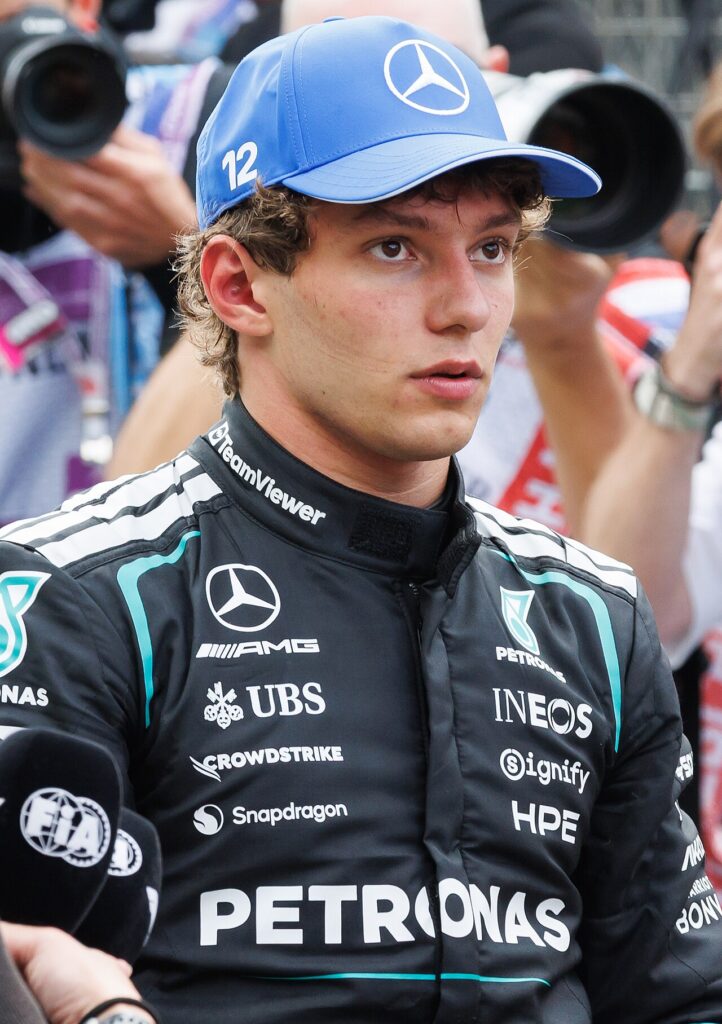
Image: Steffen Prößdorf / CC BY-SA 4.0, via Wikimedia Commons
Training Split
In-season, F1 drivers train around the race calendar — heavy work on Mondays and Tuesdays after a Grand Prix, tapering off by Thursday. Antonelli’s week typically breaks down like this.
Day 1: Neck and Upper Back
- Four-way neck harness isometrics (flexion, extension, both laterals) — 3 sets x 30-45 second holds per direction
- Banded lateral neck resistance (simulating cornering load) — 4 sets x 12 reps per side
- Helmet-weighted head rotations — 3 sets x 10 per side
- Face pulls — 3 sets x 15 reps
- Seated cable rows — 4 sets x 10-12 reps
- Prone Y-T-W raises — 3 sets x 12 reps
- Rest: 45-60 seconds between sets
Day 2: Lower Body and Posterior Chain
- Goblet squats — 4 sets x 10 reps
- Romanian deadlifts — 4 sets x 8 reps
- Bulgarian split squats — 3 sets x 10 per leg
- Single-leg calf raises — 3 sets x 15 per side
- Leg press (heavy, braking-specific) — 4 sets x 6-8 reps
- Glute bridges — 3 sets x 15 reps
The leg press matters more than it looks. An F1 brake pedal takes well over 100 kg of force at peak with no servo assistance, and he’s hitting that up to 70 times a race.
Day 3: Conditioning and Core
- Rowing intervals — 10 x 500m, 60 seconds rest
- Pallof press — 3 sets x 12 per side
- Side plank with reach-through — 3 sets x 45 seconds per side
- Hanging leg raises — 3 sets x 12 reps
- Ab wheel rollouts — 3 sets x 10 reps
- Dead bugs — 3 sets x 20 total
Day 4: Upper Body Push and Grip
- Incline dumbbell press — 4 sets x 8-10 reps
- Overhead press — 3 sets x 8 reps
- Pull-ups — 4 sets to near-failure
- Lateral raises — 3 sets x 15 reps
- Farmer’s carries — 4 sets x 40m
- Wrist curls and reverse curls — 3 sets x 15 each
- Plate pinch holds — 3 sets x 30 seconds
Day 5: Reaction and Simulator Work
Light physical load, high neurological load: light board drills, Batak-style reaction panels, and long simulator stints at Brackley that double as heat and concentration training.
Cardio Routine
Cycling is the backbone — low-impact, builds aerobic base without adding mass, and possible anywhere on the calendar. Expect 60 to 120 minutes of steady-state road riding two or three times a week, plus running sessions of 5-8 km.
High-intensity work comes from rowing and bike intervals, because racing heart rates sit between 150 and 180 bpm for the full distance and drivers need a ceiling well above that. Antonelli has also done heat acclimatisation work — training in heated rooms or heavy layers ahead of races like Singapore and Qatar, where cockpit temperatures push drivers toward 60 degrees Celsius of body stress.
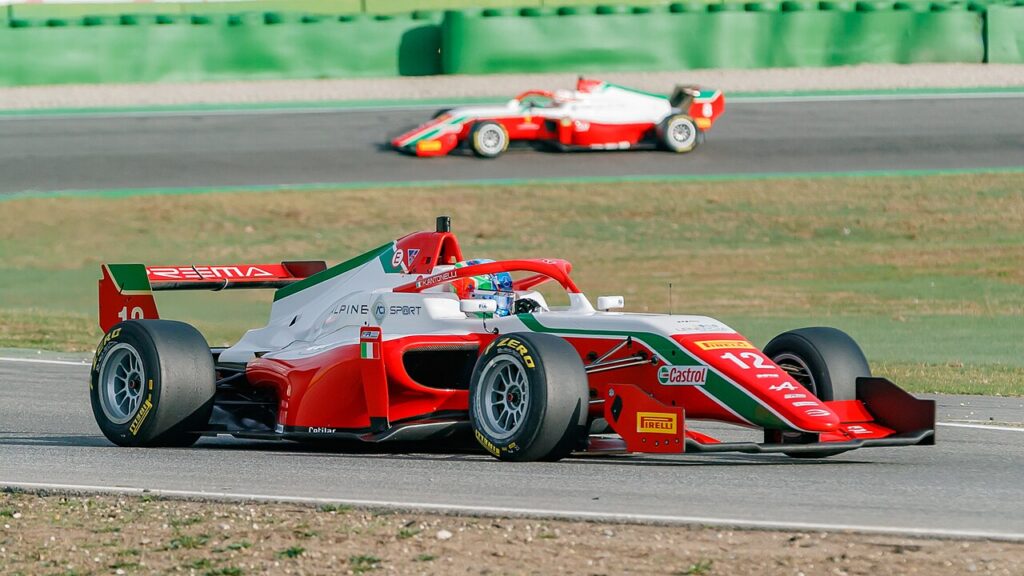
Image: Steffen Prößdorf / CC BY-SA 4.0, via Wikimedia Commons
Role-Specific Training: Preparing for the Mercedes Seat
When Mercedes confirmed him for 2025 in September 2024, he had about four months before the Australian Grand Prix opener. That window went almost entirely on neck strength, grip endurance, and heat tolerance — the three areas where F2 doesn’t prepare you for F1.
The neck work is relentless and boring: harness holds, banded resistance, weighted helmet drills, done daily or near-daily in short blocks rather than one big session, because the neck recovers quickly and responds to frequency. Antonelli also ran a heavy TPC (Testing of Previous Cars) program in 2024, logging thousands of kilometres in older Mercedes machinery — physical conditioning as much as technical learning.
The payoff showed early. He finished fourth on debut in Melbourne, took a sprint pole in Miami, and scored a podium in Brazil in his rookie season — never missing a race through fatigue or injury.
Recovery and Flexibility
Sleep is the big one and the hardest to protect across 24 races and multiple continents. Antonelli targets 8-9 hours, uses team-managed travel and light-exposure protocols to blunt jet lag, and naps on long-haul flights.
Post-session recovery includes sports massage (neck, traps, and forearms take the worst of it), mobility work for thoracic rotation and hip flexors, and ice baths or cold showers after hot races. Hydration is managed clinically — drivers can lose 2-3 kg of fluid in a single Grand Prix, so electrolyte loading starts days before, not on race morning.
Personal Trainer
Antonelli works within Mercedes’ driver performance department, which handles physical conditioning, nutrition, and travel recovery for both race drivers, alongside his own trainer and physio who travel with him. Like most Italian junior drivers, his early conditioning ran through the national karting and Formula 4 system, which leans heavily on cognitive and reaction training alongside physical work — a philosophy popularised by Formula Medicine in Viareggio, long a fixture for Italian single-seater talent.
His father, Marco Antonelli, who runs AKM Motorsport, has managed the overall program since Kimi was a kid, including the decision to keep his physical development gradual rather than forcing early bulk.
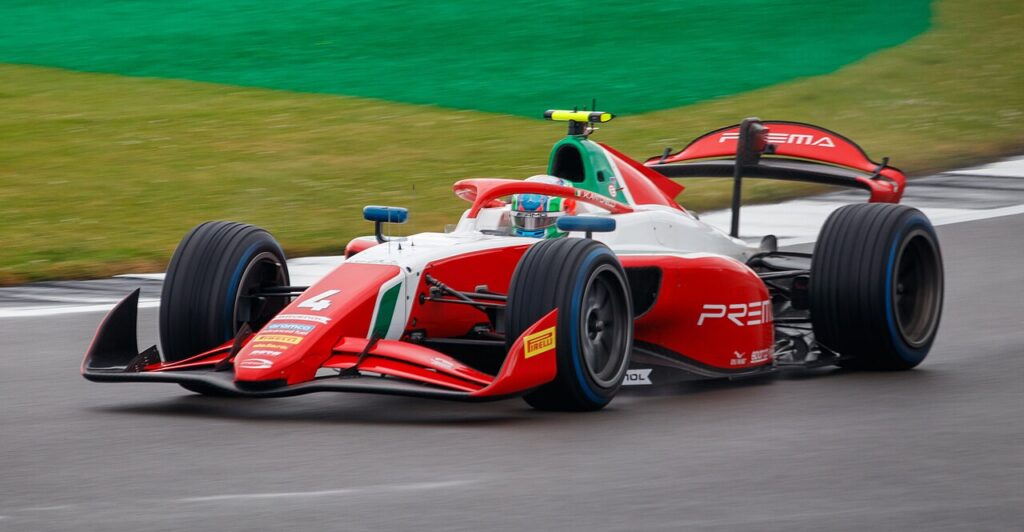
Image: Jen Ross / CC BY 2.0, via Wikimedia Commons
Workout Stats
| Metric | Detail |
|---|---|
| Training Frequency | 5-6 days/week (tapered on race weekends) |
| Session Duration | 60-90 minutes |
| Primary Focus | Functional strength and endurance — neck, core, grip |
| Cardio | Cycling, running, rowing intervals — 45-90 min/day |
| Weight Target | Kept lean under FIA driver minimum weight rules |
| Recovery | 8-9 hours sleep, massage, cold exposure, mobility work |
Frequently Asked Questions
How does Andrea Kimi Antonelli work out?
He follows a four-day split built around neck and upper back, lower body and posterior chain, conditioning and core, then upper-body push and grip work. The goal is strength and heat tolerance without adding bulk that would hurt his weight-limit performance.
How often does Andrea Kimi Antonelli train?
He trains roughly four to five structured sessions a week, scheduled around the race calendar. Heavy work falls on Mondays and Tuesdays after a Grand Prix, then tapers off by Thursday ahead of track running.
What are Andrea Kimi Antonelli’s key exercises?
Four-way neck harness isometrics, banded lateral neck resistance, heavy leg press, Romanian deadlifts, Pallof presses, hanging leg raises, farmer’s carries and pull-ups are staples of his program.
Why does Antonelli train his neck so much?
F1 cars generate up to 5G in corners, loading the neck and torso far beyond what he experienced in Formula 2. He spent the 2024-25 off-season largely closing that physical gap before taking Lewis Hamilton’s Mercedes seat.
What cardio does Andrea Kimi Antonelli do?
Rowing intervals are his main conditioning tool, typically 10 x 500m with 60 seconds of rest. That aerobic base helps him survive two hours in a cockpit that can hit 50 degrees Celsius.
Does Andrea Kimi Antonelli lift heavy or avoid bulk?
He deliberately avoids bulk. At about 5’10” and under 70 kg, he keeps muscle mass functional because every unnecessary kilogram works against him under F1’s minimum weight rules.
More Andrea Kimi Antonelli Celebrities

Trending Now



Recommended Fitness Gear
Last Updated: October 31, 2026 | Source: Healthy Celeb