This article contains affiliate links. We may earn a small commission if you purchase through these links, at no extra cost to you.
Lewis Hamilton’s Diet Overview
Lewis Hamilton is the most statistically successful driver in Formula 1 history — seven world titles, 100+ pole positions, and since 2025, a Ferrari seat. He’s also the sport’s most prominent vegan, and that combination is exactly why his eating habits get searched more than any other driver’s.
Here’s why it matters mechanically. F1 regulations set a minimum combined weight for driver plus seat (82 kg for 2025), and anything over that is dead weight the car has to carry. Naturally heavy drivers lose lap time; drivers who starve themselves can’t hold their head up under 5G cornering loads. Cockpit temperatures routinely top 50°C, and drivers can sweat off 2 to 3 kg across a Grand Prix while holding an average heart rate around 160–170 bpm for 90 minutes straight. The job demands a lean, strong neck and torso, serious aerobic conditioning, and enough fuel to survive heat stress — all without going over a number on a scale.
Lewis Hamilton does all of that on plants. He stands 1.74 m (about 5 ft 8.5 in) and races at about 73 kg. He cut meat out gradually starting in 2017 after watching documentaries on factory farming and health, dropped fish and dairy shortly after, and has been fully plant-based since. He’s said repeatedly that his energy and recovery improved after the switch, and he co-founded the vegan chain Neat Burger in 2019.
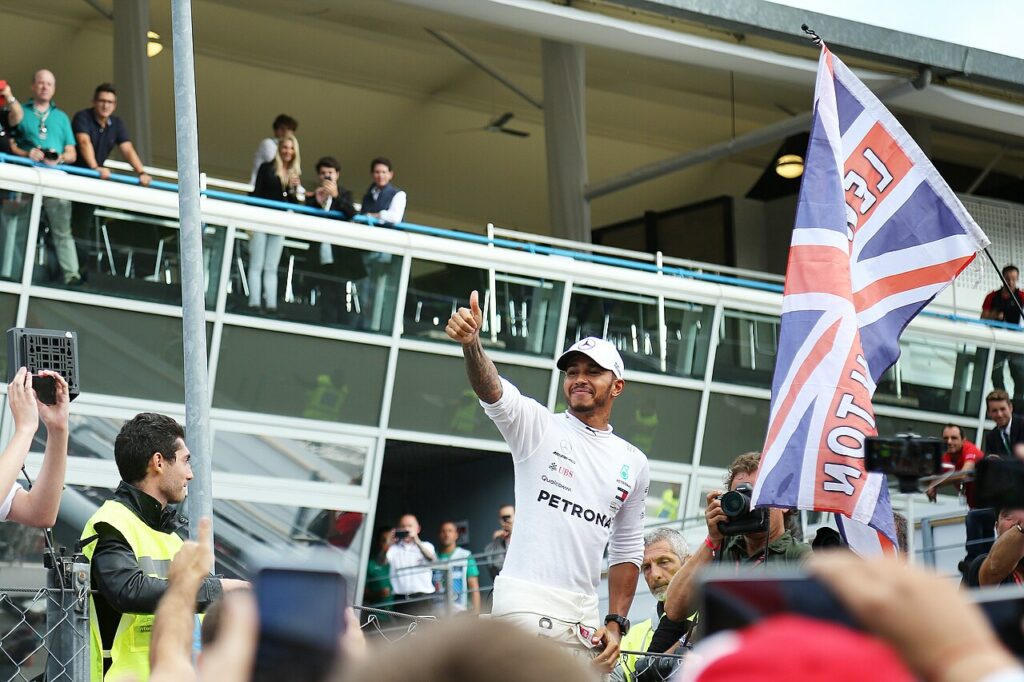
Image: https://www.flickr.com/photos/78475089@N02/ / CC BY-SA 2.0, via Wikimedia Commons
What Lewis Hamilton Eats in a Day
Hamilton travels with chefs and has worked with Hintsa Performance, the Finnish group behind the physiology programs for much of the F1 grid. He’s never published a rigid daily menu, but between interviews, social posts, and his restaurant work, the pattern is clear. Below is a representative race-week day.
Breakfast
A large green smoothie is his most consistent habit — spinach or kale, banana, berries, almond or oat milk, flax or chia, and a scoop of plant protein. On heavier training mornings he adds oats or sourdough toast with avocado and tomato, or a tofu scramble with turmeric, peppers, and black beans. Black coffee. About 600–750 calories depending on whether he’s training.
Mid-Morning Snack
Fruit, nuts, or a date-and-nut bar. During race weekends this is deliberately small — he’s in and out of the car, and nobody wants a full stomach under braking loads.
Lunch
Usually his biggest structured meal: a grain bowl built on quinoa, brown rice, or lentils with roasted vegetables, chickpeas or tempeh, greens, and a tahini or avocado dressing. He’s a fan of Caribbean-influenced plant cooking too — jerk-spiced jackfruit, rice and peas made without animal fat, plantain. Call it 800–900 calories.
Afternoon Snack
Hummus with vegetables or pita, a handful of almonds, or a second smaller smoothie. Electrolyte drinks go in here during hot rounds like Singapore, Qatar, and Bahrain — hydration starts 48 hours before the race, not on the grid.
Dinner
Lighter and protein-forward: lentil or bean stew, vegan curry with chickpeas and spinach, wholegrain pasta with tomato-lentil ragu, or grilled tofu with sweet potato and greens. Plenty of olive oil and seeds for fat.
Evening / Before Bed
Herbal tea, sometimes fruit or a vegan dessert. Hamilton has talked openly about prioritizing sleep and meditation, and keeps the last meal early enough not to wreck it.

Image: rsyphotography / CC BY 2.0, via Wikimedia Commons
Diet Rules and Principles
No meat, no fish, no dairy, no eggs — full stop, and for ethical reasons as much as performance ones. Beyond that:
- Whole foods first. He eats vegan junk food, but the base is legumes, grains, vegetables, nuts, and seeds.
- Protein spread across the day rather than loaded into one meal — tofu, tempeh, lentils, beans, pea protein.
- Hydration as a performance variable. He front-loads fluids and electrolytes before hot races, since in-car drink bottles only hold around half a litre.
- No alcohol during the season. He’s described himself as barely drinking, and it’s off the table mid-championship.
- Timing around the car. Lighter, lower-fibre meals close to sessions; bigger refuelling after.
He follows no branded protocol — no keto, no strict intermittent fasting plan he’s publicly committed to. It’s a whole-food plant-based diet managed around a calendar of 24 races.
Supplements
Hamilton has never released a full supplement stack, so anything beyond the basics is speculation. Standard and near-certain for a vegan endurance athlete: vitamin B12 (unavoidable on a plant-based diet), vitamin D, algae-based omega-3 (DHA/EPA), and plant protein powder — he’s visibly used protein in smoothies. Add electrolyte and carbohydrate drinks during race weekends, plus likely iron and zinc monitoring through team bloodwork. F1 drivers are tested constantly, so deficiencies get caught early.
Cheat Meals and Indulgences
Hamilton’s admitted to a serious sweet tooth. Vegan doughnuts, dairy-free chocolate, vegan ice cream, and pizza with plant cheese all show up. Neat Burger exists partly because he wanted a burger and fries he could actually eat. The indulgences are still plant-based — he just doesn’t pretend he lives on kale.
Estimated Daily Macros
| Nutrient | Amount |
|---|---|
| Calories | ~2,900 kcal |
| Protein | ~150g |
| Carbohydrates | ~380g |
| Fat | ~85g |
That’s about 2 g of protein per kg of bodyweight — high for a plant-based eater, but achievable with tofu, tempeh, lentils, and a daily protein shake. Calories drop on rest and travel days and climb after hot races.

Image: nabtifal / CC BY 2.0, via Wikimedia Commons
Expert Verdict
This one actually translates well. A whole-food vegan diet built on legumes, grains, vegetables, nuts, and seeds is one of the better-evidenced eating patterns for cardiovascular health, and Hamilton’s version isn’t gimmicky — no extreme restriction, no fasting windows, no elimination beyond animal products.
The caveats are real though. B12 supplementation isn’t optional here, and iron, zinc, iodine, and omega-3 intake need actual attention. Hitting 150 g of protein on plants takes planning most people won’t do. And the calorie total is built for an athlete burning through 90-minute sessions at 170 bpm in a 50°C cockpit — scale it down hard if you’re at a desk. Strip the race-specific volume away and you’re left with a genuinely sensible, sustainable way to eat.
Frequently Asked Questions
What does Lewis Hamilton eat in a day?
A typical day is a large green smoothie or tofu scramble for breakfast, fruit and nuts mid-morning, a grain bowl with quinoa, chickpeas or tempeh and tahini dressing for lunch, hummus and veggies or electrolytes in the afternoon, and a plant-based dinner. Everything he eats is 100% vegan.
What does Lewis Hamilton eat for breakfast?
His most consistent habit is a big green smoothie with spinach or kale, banana, berries, almond or oat milk, flax or chia and plant protein. On heavier training mornings he adds oats, sourdough toast with avocado and tomato, or a turmeric tofu scramble with black coffee.
What foods does Lewis Hamilton avoid?
He avoids all animal products — meat, fish, dairy and eggs. He cut meat out gradually starting in 2017 after watching documentaries on factory farming and health, then dropped fish and dairy soon after.
How does Lewis Hamilton get enough protein on a vegan diet?
He relies on lentils, chickpeas, tempeh, tofu, quinoa, black beans, nuts and seeds, plus plant protein powder blended into his daily smoothie. He also co-founded the vegan chain Neat Burger in 2019.
Why did Lewis Hamilton go vegan?
He switched for ethical and health reasons after watching documentaries on factory farming, and has said repeatedly that his energy levels and recovery improved once he went fully plant-based.
How does Lewis Hamilton manage his weight for Formula 1?
F1 sets a minimum combined driver-and-seat weight of 82 kg for 2025, so Hamilton races at around 73 kg at 1.74 m while keeping a strong neck and torso. He front-loads hydration up to 48 hours before hot races like Singapore, Qatar and Bahrain, where drivers can sweat off 2–3 kg.
More Lewis Hamilton Celebrities

Trending Now



Recommended Fitness Gear
Last Updated: October 12, 2026 | Source: Healthy Celeb